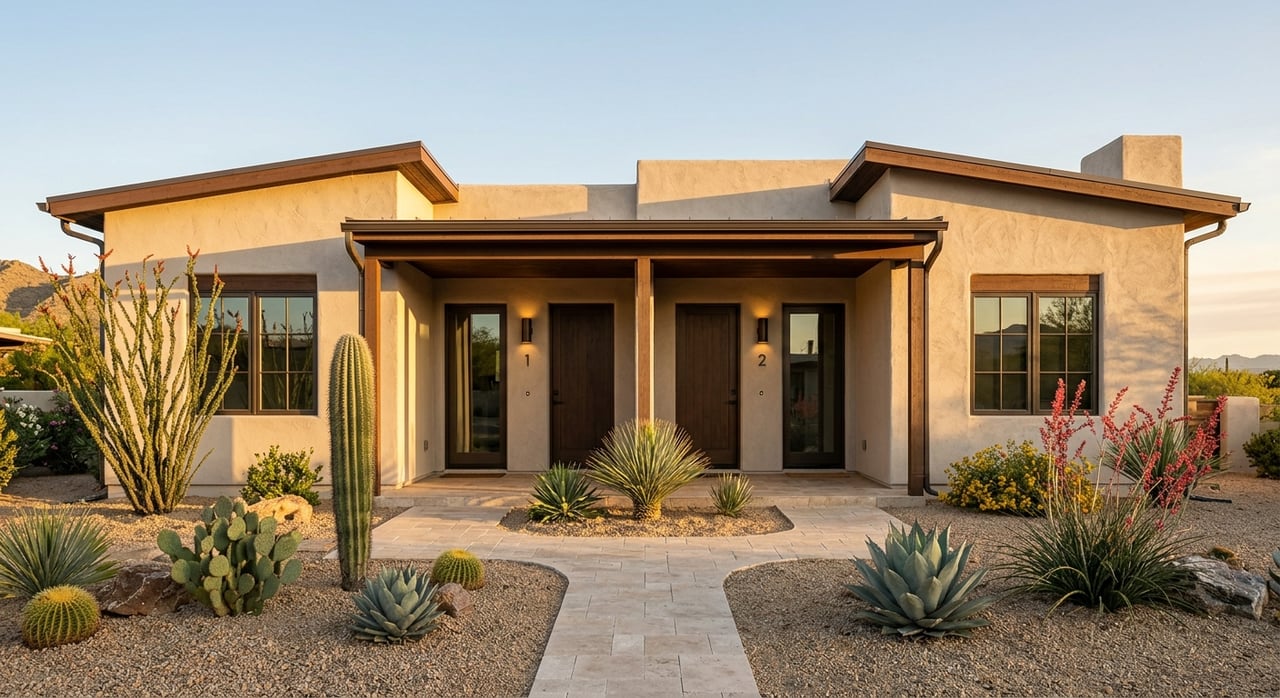
Tucson Small Multifamily Investing: Duplex to Fiveplex
April 23, 2026
April 23, 2026
If you have been eyeing Tucson duplexes, triplexes, or small apartment buildings, you have probably noticed one thing already: this is not a market where one average tells the whole story. A property near the University of Arizona behaves differently from one in Catalina Foothills or South/Airport, and financing can change fast once you move from four units to five. This guide will help you understand how Tucson’s small multifamily market works in 2025, what numbers matter most, and how to evaluate opportunities with more confidence. Let’s dive in.
Tucson’s investment appeal starts with a market that has stayed relatively steady even as apartment fundamentals have softened. In Q2 2025, the local economy showed median household income of $74,500, nonfarm employment of about 399,200, unemployment at 4.1%, and population growth of 0.7% year over year, according to PICOR’s multifamily market report.
At the same time, small multifamily investors need to stay realistic. That same report showed Q2 vacancy at 8.65% with gross rent at $1,156 per unit, while a later Q4 PICOR report put vacancy at 9.56%, rents at $1,130, and concessions at $61 per unit. That means Tucson can still offer opportunity, but it rewards careful underwriting instead of overly optimistic projections.
If you are investing in Tucson duplexes and small multifamily, the biggest mistake is treating the metro like one uniform market. Tucson is much more of a neighborhood-by-neighborhood investment landscape.
In Q2 2025, Catalina Foothills had one of the lowest vacancy rates at 6.55%, and Northwest Tucson followed at 6.95%, based on PICOR’s Q2 report. By contrast, Flowing Wells posted 10.52% vacancy in Q2, while by Q4 the highest vacancy had shifted to Southeast Tucson at 14.23%, with North Central at 10.80% and Flowing Wells at 10.30%.
That tells you something important: location inside Tucson matters just as much as the property itself. A clean duplex in a stronger submarket may perform very differently from a similar-looking one in an area with more turnover, softer rent growth, or heavier concessions.
A useful way to think about the local market is in three broad categories drawn from the brokerage research:
Each bucket comes with a different risk and management profile. Stabilized areas may offer lower vacancy but can be harder to buy at attractive pricing. Student-influenced areas may have recurring demand, but leasing can be more cyclical. Value-add corridors may offer upside, but they often need tighter controls on repairs, collections, and renovation budgets.
If you are considering a duplex or fourplex near the University of Arizona, make sure you account for seasonality. Brokerage research cited in the PICOR report found that Downtown Tucson-University was the only submarket to post a year-over-year vacancy increase in early 2025, which supports the idea that student-cycle demand can be uneven.
That does not make those properties bad investments. It simply means you should plan for a different leasing rhythm, a different tenant profile, and possibly more turnover than you might expect in other submarkets.
The Tucson market is sending a mixed but useful message to investors. There is still buyer interest, especially for smaller value-add opportunities, but operating conditions are more competitive than they were during tighter vacancy periods.
PICOR reported strong buyer interest in 5-100 unit value-add deals and seller-financed transactions in Q2 2025. By Q4, the market showed average cap rates of 5.5%, a median sale price of $119,900 per unit, and an average traded property year of 1983, according to the brokerage research summarized in the market reports. That age profile matters because many traded assets are older properties that may need upgrades, deferred maintenance review, or more active management.
In practical terms, you should be conservative with your assumptions on:
Older duplexes and small apartment buildings can still make sense, but only if you buy with enough margin for the real cost of ownership.
One of the most important investing decisions is not just what you buy, but how many units it has. In Tucson, a fourplex and a fiveplex may look similar on paper, yet the financing can be very different.
For 2-4 unit properties, buyers who plan to live in one unit may be able to use residential-style lending. Fannie Mae’s rental income guidance allows rental income from a two- to four-unit principal residence when the borrower occupies one unit. Freddie Mac guidance, as cited in the research, shows maximum loan-to-value ratios up to 95% for a 2-unit primary residence and 80% for a 3- or 4-unit primary residence, while 2- to 4-unit investment properties are capped at 75% LTV.
That creates a meaningful advantage for house hackers and owner-occupants. If you live in one unit, your cash needed to close may be much lower than if you buy the same property strictly as an investment.
Once a property has 5 or more units, it generally falls into commercial or multifamily lending. Fannie Mae’s Small Mortgage Loan Program covers existing stabilized properties with 5 or more units, up to $9 million, with up to 80% LTV and a minimum 1.25x DSCR.
That shift matters because commercial underwriting focuses more heavily on property performance than personal income alone. So if you are comparing a fourplex with a fiveplex in Tucson, do not assume the same financing path, closing timeline, or down payment structure.
Tucson lender commentary in PICOR’s Q2 report suggested multifamily projects were being priced in the mid- to high-6% range, with average loan-to-cost around 65.72%. The Q4 report added that stabilized deals were mainly being financed by banks and credit unions, with pricing in the high 5s to low 6s over the 5-year Treasury.
The key takeaway is simple: leverage has been fairly conservative. In this kind of environment, strong deals still get financed, but weaker deals or aggressive assumptions can struggle.
Before you buy, make sure you understand the operating rules that shape day-to-day ownership. Arizona law directly affects cash flow timing, move-out procedures, and tenant communication.
Arizona does not allow local rent control on private residential property. That gives owners consistency at the state level, but it does not remove the need to price units based on actual market conditions.
Arizona’s security deposit statute is especially important for duplex and small multifamily owners. The law caps security and prepaid rent at one and one-half months’ rent, requires move-in documentation and notice that the tenant may attend the move-out inspection, and requires an itemized refund statement within 14 days after termination, possession delivery, and tenant demand.
If the landlord does not comply, the tenant may recover twice the amount wrongfully withheld. For small investors, that means your lease paperwork, inspection process, and bookkeeping need to be organized from day one.
Arizona law also requires landlords to keep properties fit and habitable, maintain common areas, and keep supplied systems like plumbing, heating, ventilation, air-conditioning, and hot water in working order where provided. Under Arizona’s landlord obligations statute, tenants also have responsibilities, including keeping the unit clean and notifying the landlord in writing of needed repairs.
For month-to-month tenancies, either party can terminate with at least 30 days’ written notice. For nonpayment, the landlord must give a 5-day notice before filing an eviction action. These timelines affect turnover planning, delinquency response, and reserve planning, especially in smaller properties where one vacancy can have a big impact.
In today’s Tucson market, discipline matters more than speed. You do not need perfect market timing, but you do need realistic assumptions.
When reviewing a duplex, triplex, fourplex, or small apartment property, focus on these questions:
A good deal in Tucson is often less about chasing the highest projected return and more about buying a property where the numbers still work after you stress-test them.
Small multifamily investing in Tucson is not just about finding a building. It is about understanding submarkets, financing thresholds, property age, and local operating realities before you write an offer.
That is where a local agent can add real value. According to the Got Your 6 Homes about page, Jessica Sanchez has called Tucson home for more than 35 years, has worked as a full-time Realtor since 2002, serves Tucson and surrounding areas, and offers access to private and off-market listings.
For local and out-of-state investors alike, that kind of on-the-ground support can help you compare neighborhoods, coordinate walkthroughs, line up inspections, gather insurance and lender input, and move through due diligence with fewer surprises. If you want practical help evaluating Tucson duplexes and small multifamily opportunities, connect with Jessica Sanchez for local guidance and a clear next step.
Stay up to date on the latest real estate trends.
Jessica Sanchez has worked in the real estate industry for over 20 years and has amassed a renowned class of clientele and unmatched experience.
Let's Connect
Jessica Sanchez
6444 E Tanque Verde Rd, Tucson, AZ 85715